Announcement
Jun 10, 2026
Oracle Forms Automation: A Hybrid iPaaS + RPA Approach for Legacy Enterprise Systems
Oracle Forms still runs core business processes inside thousands of enterprises, two decades after Oracle effectively stopped marketing it as a strategic platform. It powers transactions inside Oracle E-Business Suite, holds procurement and inventory workflows that have been customized for fifteen or twenty years, and serves as the user interface for financial systems the rest of the modern stack depends on. The official Oracle modernization path moves Forms applications to APEX, ADF, or Oracle Fusion. For most enterprises running EBS today, that migration is a multi-year, multi-million-dollar project that has not been budgeted and may never be.
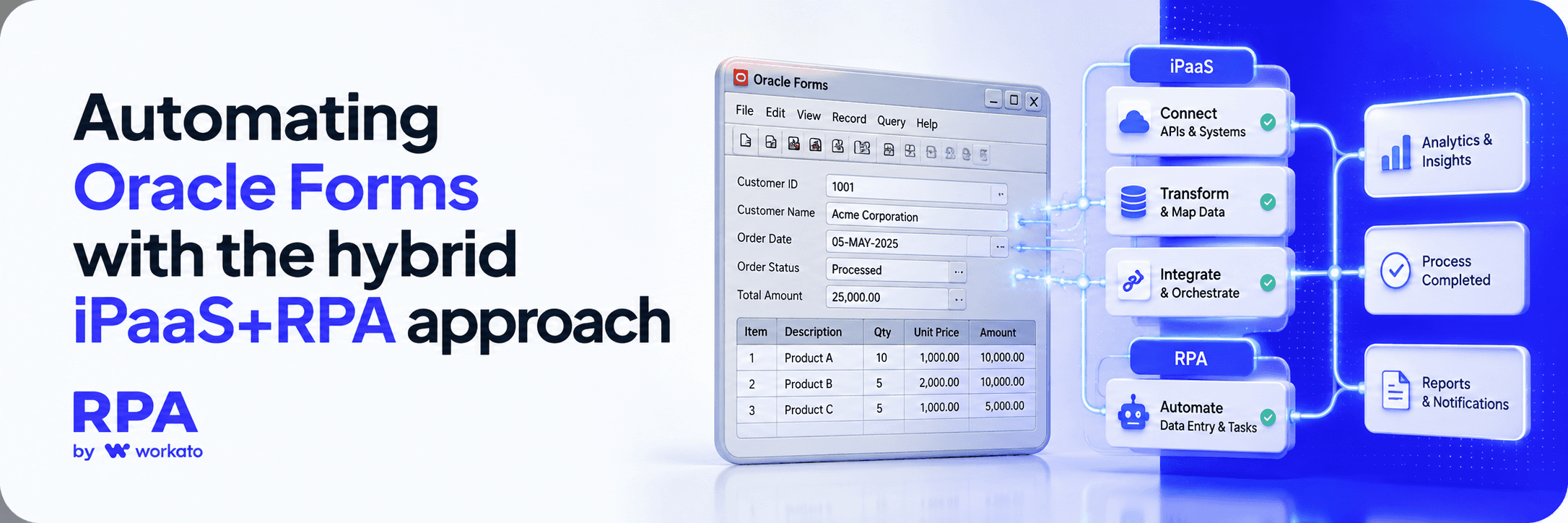
The pragmatic alternative is to leave Oracle Forms running and automate around it. Oracle Forms automation through a hybrid iPaaS + RPA approach has become the standard pattern in industries where Forms-based workflows are not going away in any practical timeframe: banking, insurance, manufacturing, public sector, telco. Workato orchestrates the business workflow across modern SaaS and ERP systems. Robotiq.ai's RPA bots execute the operations inside Oracle Forms that no API can reach. The combination delivers automation across the full ERP surface without forcing a platform migration.
Why Oracle Forms is still running enterprise workflows
Oracle Forms is the dominant client technology inside Oracle E-Business Suite, which itself remains in production at thousands of enterprises across finance, supply chain, HR, and procurement. The reasons it has not been replaced are structural, not technical.
The first reason is investment. A typical Oracle EBS implementation includes hundreds of customized Forms reflecting business rules built up over a decade or more. Replacing that customization in APEX or Fusion requires rebuilding logic that often exists only in the heads of the team that built it.
The second is risk. The Forms applications running today have been in continuous production for years. They work. Replacing a system that works, in a domain like general ledger or accounts payable, is not a project most CFOs greenlight casually.
The third is modernization fatigue. Most enterprises are already absorbing the SAP ECC to S/4HANA conversations, on-prem to cloud migrations, data warehouse rebuilds, and whatever AI-themed initiative is consuming budget this year. Oracle Forms migration is rarely the priority.
The result is that the systems are not going anywhere. The integration question is how to automate workflows that depend on them.
The integration problem with Oracle Forms
Oracle Forms applications expose a limited API surface to the outside world. Some operations can be reached through Oracle's published REST APIs in EBS. Many cannot. Custom Forms developed in-house typically expose nothing. Even where APIs exist, they often cover the data layer without exposing the validation and business logic the Forms screens enforce.
The deployment model adds friction. Oracle Forms applications are delivered through Oracle WebStart or a Java applet inside a browser, run inside a Citrix-published session, or accessed through VPN-protected internal portals. The execution environment is tightly coupled to the user context. Sessions time out. Authentication often requires multi-factor steps. The applications themselves expect a human at the keyboard.
For a workflow that needs Oracle Forms to participate, the integration team has historically had three options. Use the partial APIs where they exist, and accept that some steps still require a human. Build custom integrations against the database layer, which Oracle does not support and which breaks on every EBS patch. Or accept that the workflow has a manual step at the Forms screen.
None of those answers scales. All of them leave the bottleneck where it started.
Why standalone RPA falls short
The obvious response is to drop an RPA bot on top of Oracle Forms. A bot can log in, navigate screens, enter data, click through approvals, extract values, and move on. For a single, well-defined task, this works.
The problem appears at scale. Standalone RPA does not solve the orchestration problem. A bot that handles a Forms transaction needs to be triggered by something upstream. Its output needs to land somewhere downstream. If the upstream trigger is a new ticket in ServiceNow, a record in Salesforce, or a message in Slack, the bot has no native way to receive that signal. If the output needs to land in a finance data lake, a customer notification, and a compliance log, the bot has no native way to distribute it.
Standalone RPA also fragments faster than expected. Every workflow becomes its own bot. Every bot has its own credentials, its own scheduler, its own error handling. Audit trails fracture. The platform that was supposed to reduce operational overhead becomes a new operational burden.
The brittleness compounds. Oracle Forms screens change with EBS patches. Custom Forms get updated. A pure RPA approach requires bot-by-bot rework every time the underlying screen drifts. Without orchestration logic above the bots, that maintenance is purely reactive.
This is the case for the hybrid approach. Standalone RPA solves the execution problem on Oracle Forms but not the orchestration problem around it. iPaaS solves orchestration but cannot reach Forms. The combination solves both.
The hybrid iPaaS + RPA pattern for Oracle Forms automation
In the hybrid pattern, Workato handles every part of the workflow that does not touch Oracle Forms directly. Triggers come from the systems where business events actually start: a CRM, an ITSM tool, an HR platform, a vendor portal, a chat message. Workato evaluates conditions, gathers context from other systems through APIs, and decides what work needs to happen inside Forms.
When the Forms-side work is required, the recipe calls the RPA by Workato connector and hands the Robotiq bot a structured input: which Form to open, what data to enter, what to validate, what to extract.
The bot operates Oracle Forms exactly as a trained user would. It logs into the EBS environment, navigates to the Form, populates fields, handles dialogs, manages save-and-confirm cycles, and extracts results. Multi-factor authentication is handled through the bot's credential vault. Screen drift is managed centrally through Robotiq's recorder and recovery logic. The bot returns a result to Workato when the Forms work is complete.
The recipe then continues the workflow downstream. The Forms result might trigger a notification to the requesting user, an update to a CRM record, a posting to a finance data warehouse, an entry into a compliance log, or any combination of these. The entire workflow is logged in Workato's audit trail.
The maintenance burden drops because the bot logic is concentrated in one place, governed by one platform, and orchestrated by recipes that are versioned and audited like any other Workato content. The broader pattern is covered in why enterprises still run on legacy systems.
Common Oracle Forms automation use cases
Five Forms-based workflows account for most of the deployments enterprises ask about.
Vendor master data maintenance. New vendor records, banking detail updates, classification changes. Forms-based screens are still the system of record in many EBS deployments. The bot handles the screen work; Workato orchestrates the upstream approval workflow and the downstream sync to procurement systems.
Purchase order creation and approval routing. POs that originate in a procurement tool or directly in a request channel get created inside Oracle Forms by the bot, routed through approval workflows in Workato, and tracked end-to-end without a buyer ever touching the Forms screen for routine cases.
Inventory adjustments and cycle counts. Warehouse data lands in Workato through warehouse management APIs. The bot enters adjustments into the inventory Forms. Discrepancy data flows back into a reporting dashboard.
Period-end financial close steps. Specific journal entries, allocations, or reconciliations that have always required a Forms-based entry get executed by the bot at the same point in the close calendar every period. Finance teams stop spending the last two days of close doing data entry.
Customer master and credit holds. New customer onboarding, credit limit updates, hold-release workflows that depend on Forms screens get triggered from the CRM, handled by the bot, and synced back without manual intervention.
To see how the pattern applies to a specific Forms workflow, you can request a sandbox environment and walk through it with a Robotiq solutions engineer.
What enterprises plan for in production
Three implementation considerations come up consistently and are worth flagging early.
Authentication is the first. Oracle Forms environments often require MFA, sometimes through hardware tokens, sometimes through soft tokens, sometimes through SMS or email codes. The RPA platform needs to handle these credential flows securely, ideally without storing static credentials in the bot itself.
Session and connection management is the second. Forms sessions often time out, and the system the bot connects through (direct EBS, Citrix, RDP, VPN) has its own session model. Bots need to handle reconnects, queue jobs across machines, and respect concurrent-session limits.
Audit and governance is the third. Forms transactions touch financial and regulatory data. Every bot action needs to be logged in a way that satisfies audit requirements, with traceability back to the business event that triggered it. The orchestration layer in Workato handles the workflow-level audit trail; the RPA platform handles the action-level trail.
These are solvable problems and standard parts of an enterprise deployment, but they need to be addressed in the design phase, not in production.
What this changes for enterprises running Oracle EBS
For organizations running Oracle EBS today, the operational reality is that Forms-based workflows are not going to be migrated in the foreseeable future. The realistic integration question is not whether to modernize Forms, but how to automate the workflows that depend on them.
Hybrid iPaaS + RPA answers that question without forcing a migration that is not on the roadmap. Oracle Forms automation becomes part of the same orchestration layer that handles every other integration in the enterprise. Workato runs the workflow. RPA by Workato runs Forms. The Forms applications themselves keep doing what they have always done.
For teams ready to evaluate the pattern against a specific Oracle Forms workflow, book a call with the RPA by Workato team to scope a proof of concept.
Changelog